
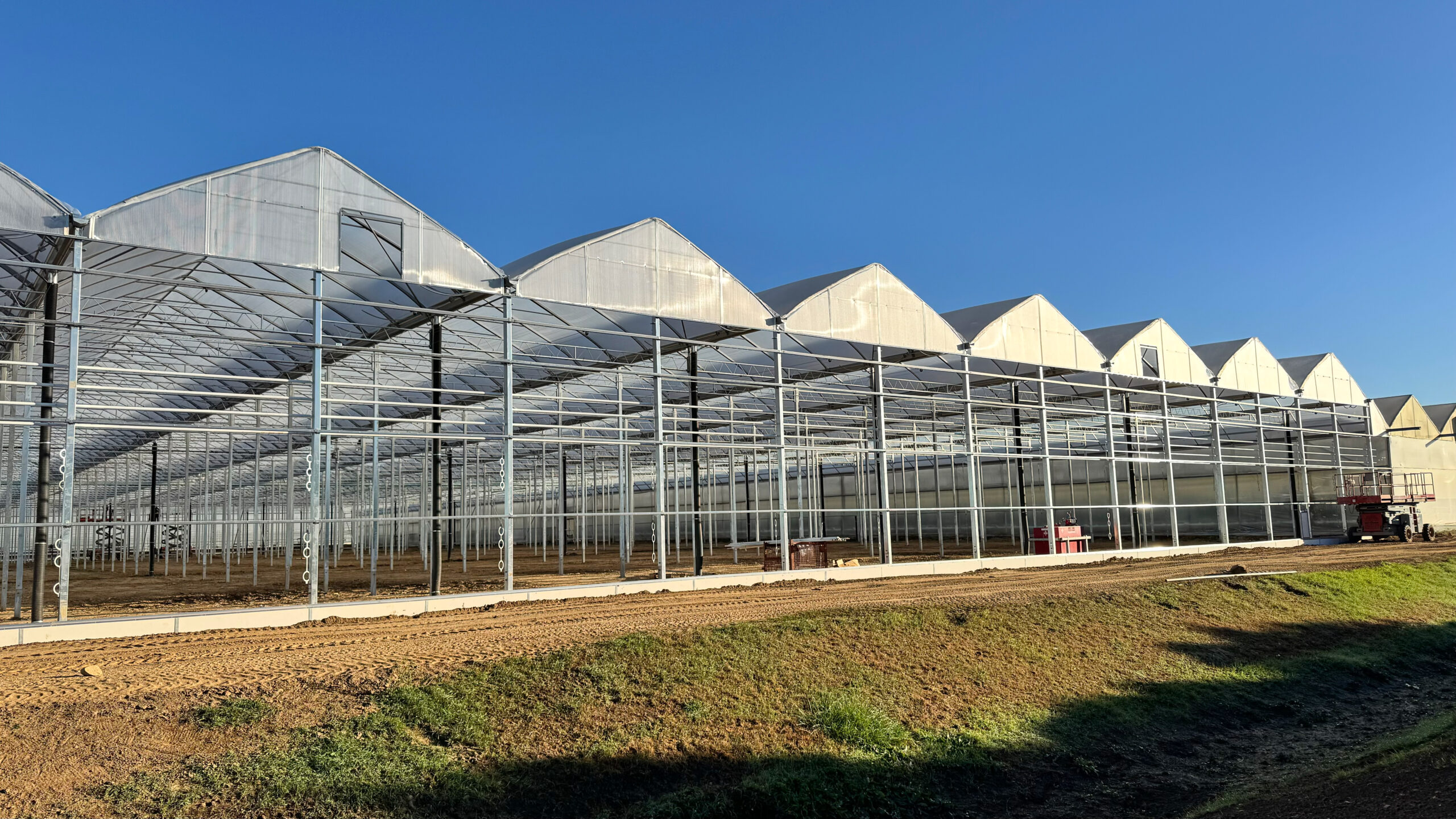
South Essex Fabricating (SEF) is a turnkey commercial greenhouse builder in Leamington, Ontario. We design, fabricate, and construct commercial greenhouse facilities and phased expansions for growers across Windsor-Essex County, Southwestern Ontario, and North America, with design, in-house steel manufacturing, systems integration, and construction management delivered by one company. Each greenhouse project runs through one team, from site plan to first crop.
Expand when your packing line, not your growing area, becomes the bottleneck. Phase the growing compartments, but size the shared infrastructure for the full build-out on day one. Oversizing site work, water storage, and electrical service in Phase One is the single decision that protects every phase after it.
Over 30 years and hundreds of acres, we have built more expansions than first-time facilities. This post answers the two questions growers ask most before committing to an expansion plan: when the numbers justify scaling, and how to phase the build so each stage pays for the next.
When Is the Right Time to Expand a Commercial Greenhouse?
Expand when you have held above 90% capacity utilization for four consecutive quarters, have committed buyer demand you are turning away, and can fund the first phase without borrowing against working capital. Two of three signals means keep planning. Three of three means start engineering.
The temptation is to expand on optimism. Growers who regret it expanded on one strong season. Growers who scale well expand on demand they can already document.
Five signals tell you the timing is right:
- Committed demand you are declining. Not forecast demand. Committed volume from buyers you already serve.
- Sustained capacity pressure. Four straight quarters above 90% utilization, not one peak season.
- Labour depth. A grower and a head of operations who can run two sites, or a hiring plan that survives contact with reality.
- Clean balance sheet timing. Phase One is funded without touching the working capital that carries you through winter.
- Utility capacity confirmed in writing. Your local distribution company has told you what service you can get and when.
That last signal is the one most growers skip, and in Southwestern Ontario it now decides schedules. RBC’s Climate Action Institute projects peak electricity demand in the Windsor-Essex and Chatham area rising from roughly 500 megawatts in 2023 to about 2,100 megawatts by 2035, driven by greenhouse growth alongside battery manufacturing. In a constrained corridor, a service upgrade can take longer to secure than the greenhouse takes to build.
The market data supports patience with a deadline attached. Statistics Canada reported total Canadian greenhouse area at 35.9 million square metres in 2025, a 1.4% increase, down from 4.0% growth the year before. Ontario greenhouses hold 64.9% of that area. Expansion has slowed, and the reason shows up in operating costs: Canadian greenhouse operating expenses rose 4.3% to $4.2 billion in 2025, with electricity alone climbing 21.2% to $181.9 million. A facility designed at today’s energy prices has to earn its heating and lighting load, not just its structure.
What Phased Greenhouse Construction Actually Means
Phased greenhouse construction splits one master-planned facility into sequential build stages, each commissioned and producing before the next begins. It is not the same as building separate greenhouses. Every phase connects into shared infrastructure that was engineered for the final acreage from the start.
Site master plan: the full-build-out drawing set covering grading, drainage, roads, water storage, utility service, and building footprints for every planned phase. It is produced before Phase One breaks ground, even though most of it will not be built for years. Without it, Phase One gets sited in a way that makes Phase Three impossible.
Gutter-connected design: a structural system where adjacent greenhouse bays share gutters and interior walls instead of standing as separate buildings. Gutter-connected ranges make phasing practical, because a new range ties into the existing greenhouse structure rather than duplicating it.
Phased commissioning: bringing climate control, irrigation, ventilation, and fertigation systems online in a finished crop zone while construction continues next door. It requires isolation valves, separate control zones, and dust barriers that have to be designed in, not added later. Without them, dust and humidity from the construction side cross into the producing crop.
Available-for-use date: the point at which a facility is ready for production rather than still under construction. This date, not the construction start date, is what tax and financing timelines are measured against.
This is the difference between a phased build and a series of unrelated projects, and it is why turnkey greenhouse solutions start with the full site rather than the first phase.
Which Systems Must Be Sized for Full Build-Out in Phase One
Site grading, storm water, water storage, electrical service, and the buried portions of the heat loop must be built to final capacity in Phase One. Growing compartments, glazing, and boiler units can be added phase by phase. Getting this split wrong is the most expensive mistake in phased construction.
This is where phasing either saves money or quietly doubles it. The rule: anything that will be buried, flooded, or blocked by a future phase gets built once, at full size. Anything above grade that stands alone can wait.
| System | Build in Phase One | Why |
| Site grading and stormwater | Full build-out | Regrading around a producing greenhouse means shutting down crop and reopening the drainage approval |
| Water reservoir and pond | Full build-out | Excavation equipment cannot reach the pond footprint once Phase Two steel is standing |
| Electrical service and transformer | Full build-out | Utility upgrade applications can outlast the construction schedule in a constrained corridor |
| Buried heat loop and header pipe | Full capacity | Header pipe runs under future compartments; boilers themselves can be staged |
| Boiler units | Stage by phase | Boilers are modular and expensive to run at partial load |
| Headhouse and packing shell | Full footprint, staged fit-out | Steel shell is cheap to oversize, and packing throughput becomes the bottleneck before growing area does |
| Growing compartments and glazing | Phase by phase | This is the true variable cost and the entire reason to phase |
The headhouse row is the one growers argue with, and the one we defend hardest. A packing and grading area sized for Phase One acreage will constrain Phase Two before the new glass is installed. An oversized shell costs far less than rebuilding a live packing operation between growing seasons.
The same logic governs greenhouse pond systems and greenhouse heating systems. Few commercial greenhouse sites can meet peak irrigation demand from a municipal water source, so reservoir volume is sized for the final acreage rather than the first phase. Storage volume and buried distribution get built once. The equipment that connects to them can be staged.
How to Sequence a Phased Greenhouse Expansion
Master plan the full site, secure permits and utility capacity for the total build, construct shared infrastructure at final capacity, then add growing compartments in stages timed to the harvest calendar. Each phase is commissioned and producing before the next one starts.
- Document the demand. Convert declined orders into a volume number, then into acres at your realistic yield, not your best-year yield.
- Master plan the full footprint. Engineer the complete site to final acreage before Phase One is designed. Orientation, road access, and pond placement are permanent decisions, and orientation sets the light transmission every future crop depends on.
- Front-load approvals and utility applications. Site plan control, building permits, conservation authority review, and electrical service applications run on their own timelines, not yours.
- Build shared infrastructure to final capacity. Grading, stormwater, water storage, service entrance, and buried heat loop get built once.
- Sequence phases around the crop calendar. Steel goes up post-harvest in late fall so glazing, shading screens, and commissioning finish for a spring start. A phase that misses its window waits a full year.
- Commission and validate before starting the next phase. Run a complete crop cycle in the new section. Yield, humidity behaviour, and crop spacing data from Phase One should inform the Phase Two specification.
Step six is where phasing earns its premium. Building 40 acres at once locks in every design assumption before a single plant goes in. Building 20 and then 20 buys a full season of real climate and yield data to refine the second half.
Steps two and three carry the most schedule risk. Our greenhouse site plans and civil engineering work produces the master plan drawing set, and the full approval path is covered in our guide to commercial greenhouse permit requirements in Ontario.
What This Means for Growers Planning Expansion Now
Growers with expansion plans should master plan the full site immediately and confirm utility capacity in writing before committing to a construction schedule. Electrical service is now the longest lead item on many Southwestern Ontario projects, ahead of steel fabrication.
Growers often ask whether the new federal capital incentives apply to a greenhouse. Usually they do not. Budget 2025 introduced 100% immediate expensing for eligible manufacturing and processing buildings acquired on or after November 4, 2025, and Ontario’s Made Manufacturing Investment Tax Credit offers up to 15% on eligible capital investment. Both measures target manufacturing and processing property. The Income Tax Act definition of manufacturing or processing excludes farming, and the Canada Revenue Agency treats greenhouses used to grow crops as farming property in CCA Class 6 or Class 8 rather than the Class 1 buildings these measures cover. Buildings used for genuine processing can be a separate question. Confirm your own position with your tax advisor before you build a schedule around any incentive date.
The deadline that does bind most Ontario growers is the utility one. Service capacity in a constrained corridor is not available on demand, which is why the electrical application sits at step three above rather than near the end.
SEF has delivered phased builds across Southwestern Ontario and into the United States. Heritage Farms at 46 acres was followed by a 44-acre second phase. Lebo Farms at 30.9 acres was followed by a 21.5-acre second phase. Nature Fresh Farms Phase 6 at 32 acres and Phase 8 at 31.96 acres ran as sequential stages of one long-term plan, and Prism Farms at 10 acres later added a 7.5-acre expansion.
Our vertically integrated model, with design, 208,000 square feet of in-house manufacturing, and greenhouse project management under one company, typically cuts total greenhouse project timelines by 25 to 30 percent versus coordinating separate design, fabrication, and installation contractors. This is a company-reported figure.
Frequently Asked Questions
How long does a commercial greenhouse expansion take from planning to first harvest?
Most commercial greenhouse expansions run 12 to 24 months from concept to first harvest. Design and permitting typically consume 6 to 12 months of that, construction 6 to 10 months, and commissioning 4 to 8 weeks. Utility service upgrades can extend the timeline independently of construction.
Is it cheaper to build a greenhouse all at once or in phases?
Building all at once costs less in total. Phasing adds remobilization, repeated site setup, and a second round of contractor scheduling. Growers accept that premium to spread capital exposure, validate yield assumptions, and match construction to confirmed rather than forecast demand.
Can you expand a greenhouse without stopping production?
Yes, with the right design. Phased commissioning uses isolation valves, separate climate control zones, and physical dust barriers so the producing crop zone stays sealed while construction continues next door. Independent ventilation holds humidity steady in that zone while the adjacent phase is still open to the weather. These provisions must be engineered into the original system design, because retrofitting them mid-project usually requires a shutdown.
What time of year should greenhouse construction start in Ontario?
Steel erection usually begins after the fall harvest so glazing, systems installation, and commissioning finish before a spring crop start. Missing that window generally pushes a phase back a full year, because starting a crop mid-season disrupts the production calendar the expansion was meant to protect.
Does a new greenhouse qualify for the federal manufacturing and processing tax incentives?
Usually not. The Income Tax Act definition of manufacturing or processing excludes farming, and the Canada Revenue Agency classes greenhouses used to grow crops as farming property rather than manufacturing buildings. The federal immediate expensing measure and the Ontario Made Manufacturing Investment Tax Credit both apply to manufacturing and processing property. Ask your tax advisor about your specific structure and how each building on the site is used.
How much extra does it cost to oversize infrastructure in Phase One?
The premium concentrates in three line items: site grading, water storage, and electrical service entrance. It does not sit in the steel structure. In most projects this front-loaded spend costs substantially less than rebuilding those same systems around a producing greenhouse two years later.
Plan Your Next Growing Phase
Greenhouse expansion planning works best when the master plan is finished before the first shovel moves, and when the systems that get buried are sized for the acreage you intend to reach, not the acreage you are building this year. Bring us your growth targets and we will work backward to the phasing plan. You can also review our completed project portfolio.
Call 519-322-5995 or email info@southsx.com to discuss your greenhouse expansion.