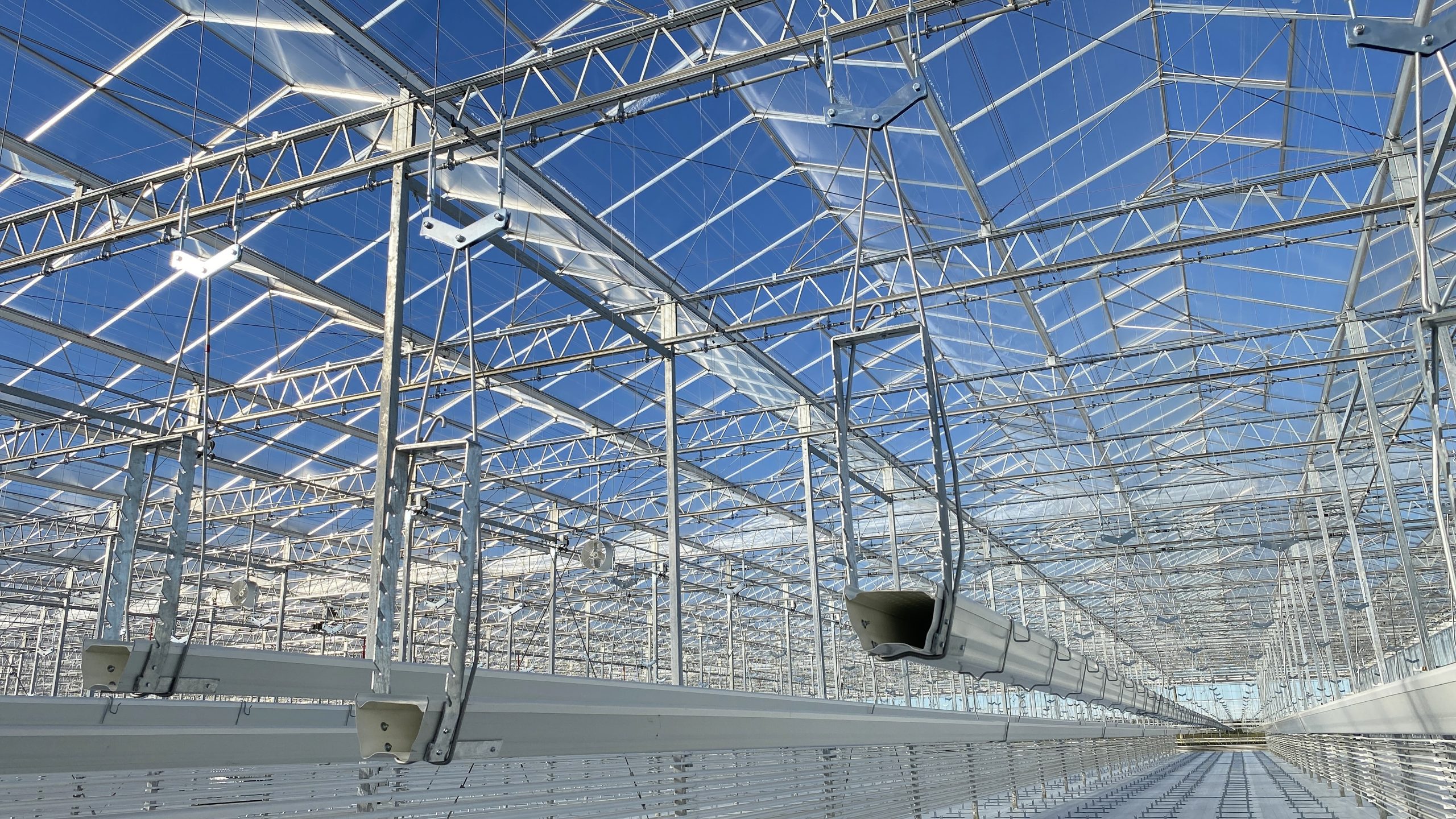
Greenhouse manufacturing in Canada produces the strongest results when one company designs, fabricates, and installs the structure. South Essex Fabricating fabricates primary steel components in-house at a 208,000 square foot facility in Leamington, Ontario. This control removes the third-party handoffs that inflate commercial greenhouse budgets and timelines.
Most growers who plan a new greenhouse assume the builder makes every part. Many builders do not. A large share of Canadian greenhouse projects run through brokers who design the structure, then send the fabrication to outside steel shops. That split creates gaps. Schedules slip, costs move, and no single company owns the outcome.
South Essex Fabricating works the opposite way. The company controls design, manufacturing, and installation under one roof. This article explains what in-house greenhouse fabrication is, how it changes your project’s cost and timeline, and what structural standards a Canadian greenhouse must meet.
What Is In-House Greenhouse Fabrication?
In-house greenhouse fabrication means the same company that designs your greenhouse also builds its primary structural components. Trusses, columns, and gutter beams are cut, welded, and finished at the manufacturer’s own facility rather than ordered from third-party steel shops.
This model is a form of vertical integration. Vertical integration is when one business owns several stages of production instead of buying them from separate suppliers. For greenhouse construction projects, that means design engineering, steel fabrication, and field installation sit inside a single organization.
The difference matters at the component level. A commercial greenhouse frame carries heavy snow and wind loads across a wide span. The trusses and columns that hold that load are the parts most sensitive to fabrication quality. When the greenhouse structural systems come from the same team that engineered the drawings, the finished steel matches the design intent exactly.
Why Does In-House Fabrication Matter for Canadian Growers?
In-house fabrication matters because it removes the single largest source of delay in commercial greenhouse construction: waiting on outside steel shops. Companies that fabricate their own components typically compress total project timelines by 25 to 30 percent and give the grower one point of accountability.
Consider a common problem. A broker-built project depends on a separate steel supplier’s schedule. If that supplier runs late, the whole build stops. The grower calls the broker, the broker calls the shop, and each blames the other. This finger-pointing costs weeks during a season where weeks decide a harvest.
An integrated manufacturer controls its own production queue. South Essex Fabricating schedules fabrication against the install date, not against an outside vendor’s backlog. The company has built more than 350 commercial greenhouse projects across North America since 1994, and that record depends on holding both ends of the schedule.
The table below shows how the two models compare.
| Manufacturing model | Who fabricates the steel | Timeline control | Accountability |
| Broker builder | Third-party steel shops | Depends on outside schedules | Split across vendors |
| Integrated manufacturer | The builder’s own facility | Controlled internally | Single source |
Single-source accountability also protects budget. Every vendor handoff adds a markup and a coordination cost. Fewer handoffs mean fewer surprise line items on the final invoice.
How Does SEF Manufacture Greenhouse Components?
South Essex Fabricating manufactures greenhouse components with laser cutting, robotic welding, and CNC machining inside its Leamington facility. The process moves from CAD drawings to finished, inspected steel without leaving the building, which keeps quality consistent across every truss and column.
The production sequence follows four stages:
- Engineering and CAD. The design team converts the greenhouse plan into precise cut files for each structural member.
- Laser cutting. Tube and plate lasers cut steel to exact tolerances, which reduces the fit-up errors that slow field assembly.
- Robotic welding. Automated welding systems join components with repeatable, uniform welds across large production runs.
- Quality inspection. In-house inspection checks each batch before it ships, so problems are caught at the source rather than on the job site.
This equipment matters for large builds. A multi-acre greenhouse needs thousands of identical parts. Automated cutting and welding hold the same tolerance on part number one and part number ten thousand. That consistency is difficult to guarantee when fabrication is spread across several outside shops.
What Structural Standards Do Canadian Greenhouses Require?
Canadian greenhouses must handle heavy snow loads, wind pressure, and freeze-thaw cycles that lighter designs cannot survive. Structures built for milder climates fail in Ontario winters, so Canadian greenhouse manufacturing requires steel engineered for regional load conditions.
Snow load is the defining factor. A greenhouse roof in southwestern Ontario carries far more weight than one in a temperate zone. The frame must move that load down through the columns to the foundation without deflection that cracks glass or tears film. Low-angle winter light adds a second design pressure, because the structure must stay strong while still letting enough light reach the crop.
In-house engineering ties directly to these standards. The gutter-connected greenhouse systems that drain melt water, and the Venlo greenhouse construction method that uses steep glass roofs, both depend on components sized for Canadian conditions. Growers can review completed greenhouse projects to see these structures in operation across the region.
Key Concepts: Understanding Greenhouse Manufacturing
Knowing a few core terms helps you compare greenhouse manufacturers on facts rather than sales claims. These concepts separate an integrated builder from a broker.
Vertical integration is when one company owns design, fabrication, and installation instead of outsourcing them. It gives the grower one contract and one accountable partner for the whole build.
Structural steel components are the trusses, columns, and gutter beams that carry a greenhouse’s load. Their fabrication quality determines how the structure handles snow and wind over decades.
Robotic welding uses automated systems to join steel with uniform, repeatable welds. It delivers consistent strength across the thousands of identical parts a commercial greenhouse needs.
Single-source accountability means one company answers for the entire project. It removes the vendor finger-pointing that stalls broker-built greenhouses when a schedule slips.
What This Means for Your Greenhouse Project
For a commercial grower, in-house fabrication translates into a shorter build, a firmer budget, and one partner responsible for the result. Choosing an integrated manufacturer reduces the coordination risk that derails multi-vendor projects.
Three steps help you evaluate any greenhouse manufacturer in Canada:
- Ask who fabricates the steel. If the answer is an outside shop, the builder does not control the schedule.
- Ask to see the facility. A working fabrication plant is direct proof of manufacturing capability.
- Ask about accountability. One contract and one project manager signal single-source responsibility.
A greenhouse is a multi-year asset. The company that builds it should still answer the phone years after the final payment. South Essex Fabricating treats each build as a long-term partnership, from the first drawing to post-completion support. Growers who are planning a greenhouse expansion can start that conversation early to protect the growing season.
Frequently Asked Questions
What does in-house greenhouse fabrication mean?
In-house greenhouse fabrication means the company that designs your greenhouse also builds its steel components at its own facility. It controls trusses, columns, and gutter beams directly instead of ordering them from third-party shops, which improves quality control and schedule reliability.
Is a Canadian greenhouse manufacturer better than importing a structure?
A Canadian greenhouse manufacturer engineers steel for local snow and wind loads that imported designs often miss. Domestic fabrication also shortens shipping timelines, simplifies warranty support, and keeps the design team reachable during and after the build.
How much faster is an integrated greenhouse builder?
Integrated greenhouse builders typically compress project timelines by 25 to 30 percent compared to broker-built projects. The saving comes from controlling fabrication in-house, which removes the waiting periods created by third-party steel suppliers working on separate schedules.
Where is South Essex Fabricating located?
South Essex Fabricating operates from a 208,000 square foot manufacturing facility at 4 Seneca Road in Leamington, Ontario. The company serves commercial growers across North America and has built greenhouse projects for more than 30 years.
What structural loads should a commercial greenhouse handle?
A commercial greenhouse in Canada must carry heavy snow accumulation and wind pressure without deflection. The frame moves this load through trusses and columns to the foundation, so the steel must be engineered specifically for the region’s climate conditions.
Build on a Foundation That Holds
Greenhouse manufacturing in Canada rewards growers who choose control over convenience. In-house fabrication keeps design, steel, and installation inside one accountable team, which protects both the budget and the calendar. If you are weighing manufacturers for a new build or expansion, South Essex Fabricating is ready to walk through your project. Contact the SEF team to start the conversation.