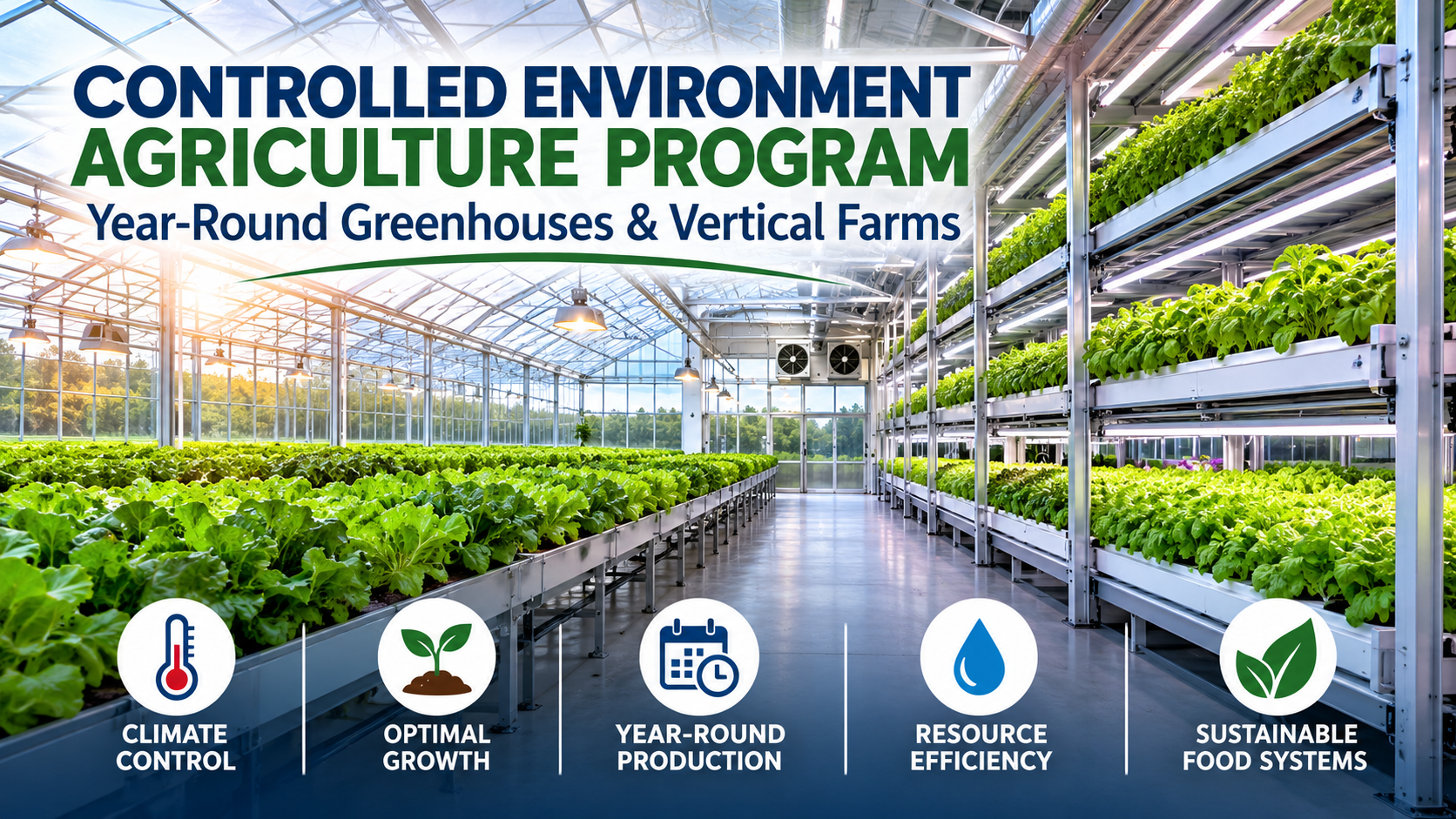
The CEA Growth Pathway Program is a $750 million Agriculture and Agri-Food Canada (AAFC) program for controlled environment agriculture. Its Technology Adoption Stream offers $100,000 to $10 million per project to build, expand or modernize fruit and vegetable greenhouses and vertical farms. AAFC covers up to 50% of eligible costs. Applications close December 23, 2026, at 12 pm (noon) Eastern Time.
Minister of Agriculture and Agri-Food Heath MacDonald launched the program on October 30. In July, we covered the $750M federal announcement for controlled environment agriculture. This guide explains who qualifies, what the money covers, and what to prepare before the deadline.
What Is the CEA Growth Pathway Program?
The CEA Growth Pathway Program is a federal fund that helps Canadian producers grow more fruits and vegetables indoors, all year. It is part of the $3.2 billion National Food Security Strategy, runs until March 31, 2033, and splits $750 million across two streams.
- CEA Technology Adoption Stream ($650 million): Supports producers in adopting, expanding and modernizing indoor growing infrastructure and technologies, including automation, robotics, lighting and digital growing tools. Most commercial growers will apply here.
- Expanding Local Food Production in Rural and Northern Communities Stream ($100 million): Supports community-driven projects that increase local food production and improve access to fresh food in communities across Canada.
Canada’s short growing season limits how much produce the country can grow for itself. The program aims to boost domestic food production, reduce reliance on imported produce and strengthen food security, so more fresh, affordable, high-quality food is grown at home.
Key Dates and Funding Terms
The intake runs from October 30 to December 23, 2026. Projects may receive $100,000 to $10 million from AAFC, and you must fund at least half of the eligible costs.
| Term | Detail |
|---|---|
| Intake opens | October 30, 2026 |
| Intake closes | December 23, 2026, 12 pm (noon) ET |
| AAFC contribution | $100,000 to $10 million |
| AAFC cost share | Up to 50% of eligible costs |
| Your cost share | At least 50% of eligible costs |
| Project length | Up to 3 years |
| Costs eligible from | June 11, 2026 |
| First intake covers | Activities in fiscal years 2026-27 to 2028-29 |
| Applications | One per applicant at a time |
AAFC may close the intake early if funding is fully committed. Do not plan to submit on December 22.
What the 50% cost share means in dollars: A grower planning a $6 million glass range expansion could request up to $3 million from AAFC. The grower funds the other $3 million through equity, Farm Credit Canada (FCC) financing or other sources. To reach the maximum contribution, a project needs at least $20 million in eligible costs.
Is the Funding a Grant or a Loan?
It can be either. AAFC generally offers non-repayable contributions to projects that create benefits beyond private gain and advance the National Food Security Strategy. Other projects may get repayable contributions. A strong application shows public benefit, such as more domestic produce in winter, lower energy use per kilogram, or new crops that cut import reliance.
Who Is Eligible to Apply?
Applicants must operate in Canada, work in indoor agriculture or a related sector (or have the skills to do so), and be a legal entity that can sign a binding agreement.
Eligible applicant types include:
- For-profit and non-profit organizations, including commercial growing operations
- First Nations, Inuit and Métis individuals, communities, governments and organizations
- Academic institutions, for late-stage variety testing that supports commercialization (research-focused projects are not eligible)
- Other levels of government
What Is Not Eligible?
Projects for ornamental plants, cannabis, animal feed or other non-food production do not qualify, unless AAFC lists them as eligible for Indigenous recipients. This matters in Ontario, where many operations grow flowers or bedding plants beside vegetables. If you run a mixed operation, confirm with AAFC how to separate food and non-food costs before you apply.
What Projects and Costs Does the Technology Adoption Stream Cover?
The stream funds the construction of new greenhouses, facility upgrades, production technology, data tools, training and novel crop development. According to AAFC’s eligibility page, eligible activities include:
- Building, expanding or modernizing growing facilities. This covers new Venlo glass greenhouses, poly ranges and full turnkey builds through complete greenhouse solutions.
- Upgrading facilities for productivity, efficiency or sanitation. Examples include energy curtains and modern climate control systems.
- Purchasing and installing equipment and technology, such as automation, robotics, monitoring systems and AI growing tools.
- Adopting and scaling technologies and production practices.
- Data management and analytical tools.
- Integrating advanced production technologies, including systems and practices for emerging or novel crops.
- Training and knowledge-sharing that builds indoor growing skills.
- Testing, adopting and expanding novel crops and varieties, plus the systems they need. Strawberry production is one example of a crop shift that cuts import dependence.
Every cost must appear in the budget you submit, relate directly to your work plan, fall within the project timeframe, and be reasonable and necessary to reach your project goals.
How Will AAFC Measure Your Project?
Your application must show how the project supports at least one of four program outcomes.
- More adoption of indoor growing infrastructure, technologies and production practices
- Better productivity, efficiency and sustainability in indoor growing operations
- More year-round or extended supply of domestically grown fruits and vegetables
- Greater diversity of fruits and vegetables grown indoors
AAFC tracks technologies adopted, facilities built or modernized, crop diversity, water use (litres per kg), energy use (kWh per kg or per m²), area used for fruit and vegetable production, sales value, and year-round production.
The strongest applications put numbers on these indicators before construction starts. If you plan to add energy curtains, state your current kWh per m² and the reduction you expect. If you plan a new range for winter production, state the added kilograms and months of supply.
Alberta Growers: How Does This Compare to the Growing Greenhouses Program?
Alberta’s Growing Greenhouses Program is a separate provincial program under the Sustainable Canadian Agricultural Partnership (Sustainable CAP). It is now closed to applications, so the federal program is the open option for Alberta operators.
The three-year Growing Greenhouses Program supports new and expanded greenhouses and vertical farms producing food at a commercial scale. It pays a 50% grant, up to $2 million per fiscal year and $4 million per applicant over the 2025 to 2028 term. At least 50% of the growing area must produce food 12 months a year, and new builds need a total project investment of at least $2 million. Alberta has 195 greenhouses producing about $145 million in produce, and 60 per cent of them operate all year.
How to Prepare a Strong Application Before December 23
We understand that this deadline lands at the end of a long growing season. These steps keep the work manageable.
- Confirm your project fits. It must focus on fruit or vegetable production and match at least one program outcome.
- Submit a Project Summary Form first. AAFC invites applicants whose summaries align with program goals to submit a full application.
- Build a schedule by fiscal year. Federal fiscal years end March 31. Map each phase to 2026-27, 2027-28 or 2028-29. A three-year window suits a phased build. Our expansion planning guide explains how to phase construction around your crop cycle.
- Get a firm, itemized budget. Fixed pricing from one builder is easier to defend than estimates pieced together from several vendors.
- Record your baseline data now. Gather current energy use, water use, yield per m², crop varieties and sales. You cannot show a percentage gain without a starting number.
- Secure your 50% share. Talk to your lender or FCC manager early. Your financing plan must be credible.
- Know the risk of early spending. Costs may count back to June 11, 2026, but AAFC funding is not confirmed until you sign a contribution agreement. Spending before that point is at your own risk.
How South Essex Fabricating Supports Funded Greenhouse Projects
South Essex Fabricating has designed, manufactured and built commercial greenhouses from Leamington, Ontario for more than 30 years, with over 350 projects completed across North America. Design, manufacturing in our 208,000 sq ft facility, and project management all sit with one team.
For a funded project, that structure matters. You get one source for the engineering drawings, itemized budget and construction schedule that your application needs. Our in-house fabrication keeps component lead times under our control, which protects a schedule tied to federal fiscal years.
AAFC makes all funding decisions. We help you plan a project that is buildable and priced with certainty.
Frequently Asked Questions
How much funding can a grower get from the CEA Growth Pathway Program?
AAFC may contribute $100,000 to $10 million per project. It covers up to 50% of eligible costs, so the grower funds at least the other 50%.
What is the application deadline?
The intake closes December 23, 2026, at 12 pm (noon) Eastern Time. AAFC may close it sooner if funding is fully committed.
Can I use the funding to build a new greenhouse or vertical farm?
Yes. Building, expanding or modernizing indoor growing facilities is an eligible activity, as long as the facility produces fruits or vegetables. Greenhouses and vertical farms both fall under controlled environment agriculture.
Are cannabis and flower operations eligible?
No. Ornamental plants, cannabis, animal feed and other non-food production are not eligible, except where AAFC specifies eligibility for Indigenous recipients.
Can I claim costs I have already paid?
Project costs may be eligible as of June 11, 2026, if they fall within the program’s cost categories and limits. Funding is not confirmed until you sign an agreement with AAFC, so early spending carries risk.
The Takeaway
The CEA Growth Pathway Program rewards projects with clear numbers: more domestic produce, less energy and water per kilogram, and new crops that replace imports. It is a major step for a stronger Canadian food system, and the window closes December 23.
If you are planning a greenhouse build or upgrade and want design drawings, fixed pricing and a phased schedule for your application, contact South Essex Fabricating or call 519-322-5995.